All four PokeInsider card indexes closed lower for the week ending November 13, 2026. The Small Cap fell 3.40% and the Micro Cap 3.35%. The Blue Chip lost 2.09%, and the Mid Cap held up best at -0.77%.
The split matters more than the direction. Nearly all of the Blue Chip’s loss came from one card, Rayquaza Gold Star. The Small and Micro Cap declines were spread across most of their members. High-end vintage is choppy but still up since launch, and the selling is in the roughly $50 to $400 cards.
Each index holds 100 cards and is price-weighted from raw (ungraded) sold prices, updated every morning. An expensive card therefore moves its index more than a cheap one. All four started at 1,000 points on October 29, 2026, so there is no monthly figure yet.
Blue Chip: one card, 20 points
The PokeInsider Blue Chip tracks the 100 most valuable Pokémon cards. It closed at 1,039.46, down 22.17 points (-2.09%), after trading between 1,035.39 and 1,064.45. It is still up 3.95% since launch, the best of the four.
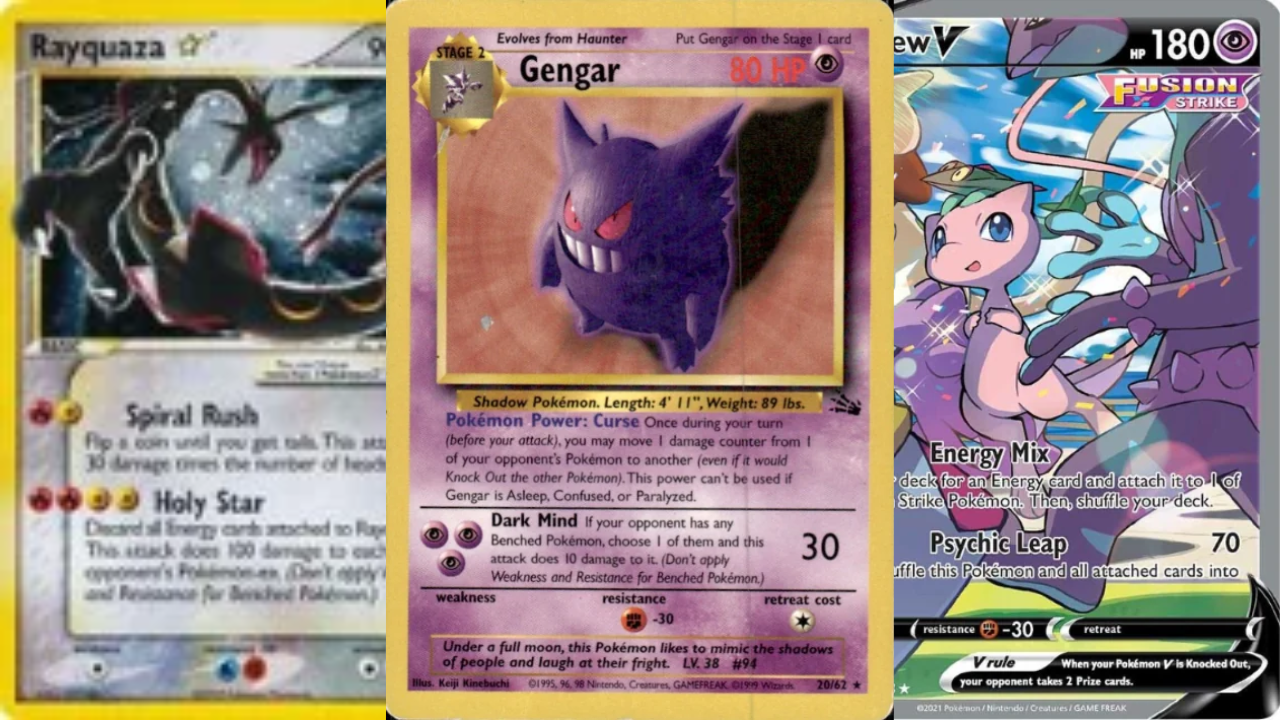
Rayquaza Gold Star (Deoxys #107) fell from $16,221.71 to $12,518.47. That 22.83% drop took 20.28 points off the index by itself. The other 99 members together cost about 1.9 points.
I looked for a reason behind the Rayquaza move and found no news, reprint or grading event that explains it. What I found is a thin market. Per eBay sold listings, raw copies sold for $7,000 and $19,000 on October 8 and $27,836 on October 11, and I could not find a newer raw sale. Raw listings over recent months range from damaged and played to near mint, so the raw price swings hard on very few sales.
Graded copies do not show the same drop. In the one like-for-like comparison I found on eBay, a PSA 8 (EU print) sold for $49,200 on November 12 against $52,600 on October 27, about 6.5% lower.
Mudkip Gold Star and Lugia look similar. Both fell hard on raw sold prices, while the TCGplayer Near Mint market price on PokeInsider’s Card Data was unchanged over 7 days for each. I found no clear reason beyond which copies happened to sell. Alakazam Gold Star is different: its TCGplayer Near Mint market price is still up 51% over 30 days, so this week’s drop gives back part of a recent run.
On the other side, three Charizards rose more than 10%, led by 1st Edition Base Set Charizard at $8,087.50 raw. I found no specific catalyst. According to PokeInsider’s Card Data (graded sold prices, November 13), the same card is $34,312.29 in PSA 9 and $272,647.53 in PSA 10. That gap suggests the raw copies trading are not near-mint candidates.
Mid Cap: steadiest of the four, sitting on its launch level
The PokeInsider Mid Cap tracks the next 100 most valuable cards after the Blue Chip. It closed at 1,000.43, down 7.80 points (-0.77%). That is the bottom of its 1,000.43 to 1,007.72 weekly range and only 0.04% above launch.
The big movers here were 20%-plus swings in single cards that mostly offset each other. Leafeon LV.X was the top contributor. Its TCGplayer Near Mint market price on Card Data also rose sharply (+50% over 7 days), so two price sources agree on direction. I found no news behind it.
The oddest pair of the week is Base Set Charizard. The 1999-2000 print rose 25.51% to $476.93 here, while the Unlimited print in the Small Cap fell 25.26% to $281.68. A week ago they were $380.00 and $376.89. No news explains two prints of the same card going opposite ways. I read it as a few raw sales in different condition, not a change in demand.
Rayquaza shows up again: the Holon Phantoms reverse holo fell 25.12% in the same week as the Gold Star. Delta Reign, the new English set headlined by Mega Rayquaza ex, released November 6, but I have no evidence linking the two.
Mew from Southern Islands fell 21.58% on sold prices, while its TCGplayer Near Mint market price rose 4.0% over 7 days. That conflict points to sale mix again.
Small Cap: broad selling, modern chase cards at the center
The PokeInsider Small Cap tracks the 100 most-traded cards priced from $100 up to the Mid Cap. It closed at 958.46, down 33.70 points (-3.40%), in a range of 956.55 to 991.20. It is down 4.15% since launch.
This decline was broad. The eight biggest movers net out to about -6.8 points, and the remaining 27 or so points came from the rest of the index.
The modern names have a clear reason: supply. Sylveon ex’s TCGplayer Near Mint market price is down 20.2% over 30 days with 29 sales, according to PokeInsider’s Card Data. Reports say Prismatic Evolutions has been reprinted through 2026. The standard Elite Trainer Box is $115.00, down 31.6% over 90 days (TCGplayer market price, per Card Data).
Mega Charizard Y ex is down 25.9% over 30 days on the same measure, with 72 sales. Ascended Heroes released in January 2026 and reports have it still restocking this fall. TCGplayer’s weekly price-drop report of November 11 said the set keeps drifting lower, with top card Mega Gengar ex well off a June high of $1,430. Card Data has that Mega Gengar ex (#284) at $622.11, down 12.4% over 7 days.
The grading math on Sylveon ex is tight. Card Data shows PSA 9 at $340 and PSA 10 at $1,000 (graded sold prices, November 13). Raw at $309.43 plus PSA’s Value tier at $39.99 (90-100 business days) comes to $349.42, more than a PSA 9 sells for. Only a 10 pays, at about 3.2 times raw.
I found no clear reason for Flareon EX’s 32.54% jump. Its TCGplayer Near Mint market price was flat over 7 days (-0.2%).
Micro Cap: closed on the low of the week
The PokeInsider Micro Cap tracks the 100 most-traded cards under $100. It closed at 956.44, down 33.19 points (-3.35%), at the bottom of its 956.44 to 983.39 range. At -4.36% since launch, it is the weakest of the four.
As in the Small Cap, the eight biggest movers net to only about -3.0 points. The other 30 or so points were spread across the index.
Three older Gengars are among the biggest drags across the Small and Micro Caps: Gengar EX full art (#114), Gengar EX (#34) and Fossil Gengar. I can’t point to a single cause. It lines up with the slide in the modern Mega Gengar ex, but that is a correlation, not a proven link.
Mega Feraligatr ex follows the Ascended Heroes supply story. Card Data shows it down 30.7% over 30 days on 112 sales, with PSA 9 at $74.50 and PSA 10 at $200.
The gainers do not look like a trend. Charizard VMAX, Pikachu VMAX and Lillie’s Determination all rose on sold prices, but their TCGplayer Near Mint market prices fell over 7 days (-0.2%, -1.4% and -10.4%). I see no clear reason for the bounces.
Sealed indexes: quiet on the surface
The sealed indexes are equal-weighted averages of daily price changes in sealed products. They started at 1,000 on August 1, 2026.
Sealed barely moved. Elite Trainer Boxes were the weakest group for both the week and the month, booster boxes were flat, and booster bundles were the only gainer.
The big sealed moves are in products released November 6, which an equal-weighted average dilutes. Per PokeInsider’s Card Data (TCGplayer market price, November 13):
All five are still above MSRP and all five are falling as supply reaches the market.
What to watch next week
- Mid Cap at 1,000.43. It sits 0.43 points above its launch level. A close below 1,000 would put three of the four indexes under where they started.
- The next raw Rayquaza Gold Star sale. The Blue Chip moves about 20 points on this one card. A new sale either confirms the $12,518.47 level or reverses it.
- Small and Micro Cap lows. The week’s lows were 956.55 and 956.44, and both indexes closed at or near them.
- Release dates. Per PokeInsider’s Release Calendar, the Mega Greninja ex League Battle Deck and Japan’s Special Deck Set MEGA (Mega Feraligatr, Mega Dragonite, Mega Gengar) release November 13. Japan’s Aura Seeker, headlined by Mega Lucario Z ex, follows on November 27, which is also Black Friday.
- December 4. The 30th Celebration Binder Collection ($31.99) and Unova Heavy Hitters Premium Collection ($59.99) release that day.
- Quarterly rebalance. New index members are announced December 4 and take effect December 21. Cards drifting across the price lines are the ones to watch: Charizard VMAX from Shining Fates is at $114.46 in an index built for cards under $100.
This report is market data, not investment advice.
What did you think?