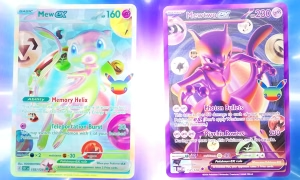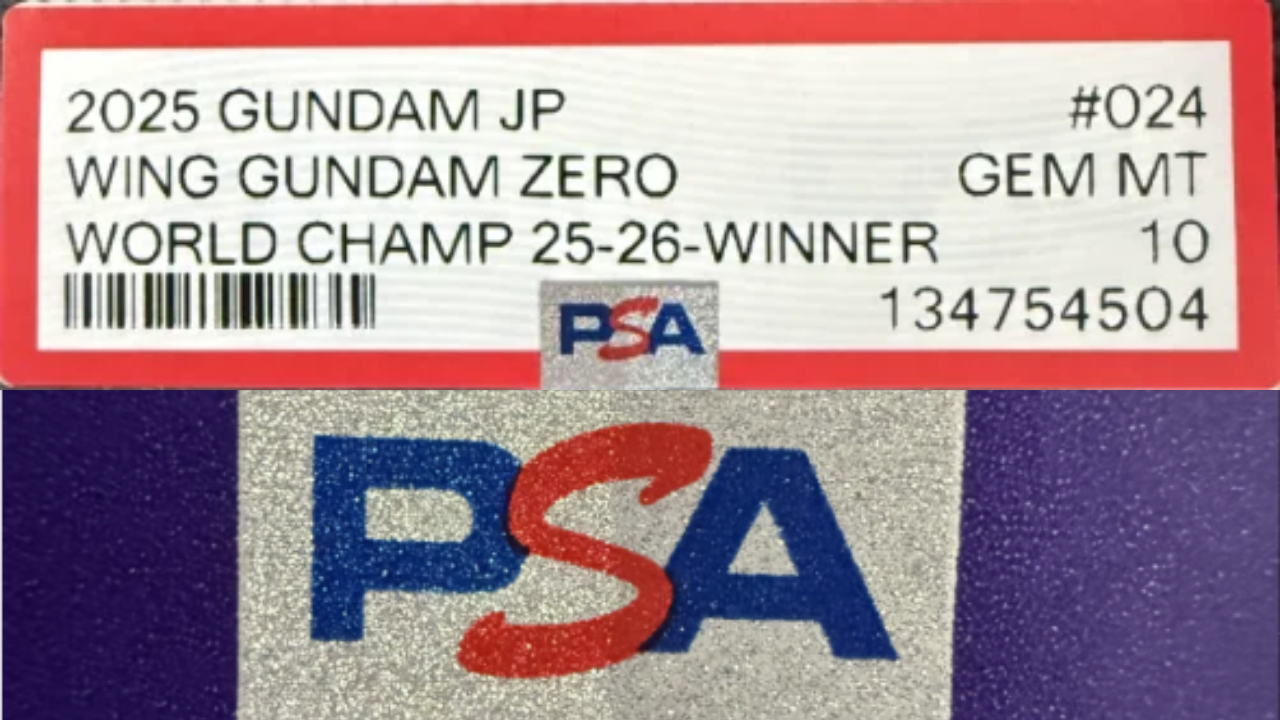
A PSA label with a cert number that checks out is no longer enough to prove a slab is real. Reports this week show AliExpress sellers printing PSA-style front and back labels for almost any card for $4.05, and some of those labels carry real, active PSA certification numbers.
Prices have not reacted so far. But anyone buying second-hand slabs now has to check the card and the case, not just the number.
What Was Found
On Nov. 8, Japanese collectors posted screenshots of an AliExpress listing for PSA-lookalike labels. According to reports published Nov. 10, the listing was priced at $4.05 and showed more than 5,000 sales. The product is a printed front label and back label with a barcode, a QR code and a holographic patch, and some stores sell it with an empty, unsealed case.
The seller markets it as a custom label, not a graded card. A sales count is also not a count of fake slabs, because some buyers want labels for custom or display cards. The worry is the buyers who put a raw card behind one and sell it as a real slab.
An authentication researcher who went through the listings found two more stores:
- One showed 170 units sold and a 4.7-star rating. Buyer review photos showed labels with PSA cert numbers that belong to a Paldean Fates Mew ex Special Illustration Rare graded PSA 9 and a Team Rocket Dark Gyarados holo graded PSA 10.
- A second showed 146 sold and prints labels to order from details the buyer sends. Its product video tilts a copied label under a lamp so the silver patch catches the light like the one on a real label.
The seller’s video also showed an active cert number for a PSA 10 One Piece card. PSA has deactivated at least two of the numbers involved, according to the researcher’s findings. The reports I have seen do not include a formal PSA statement on the listings.
Separately, a Japanese flea-market listing sold genuine labels pulled from their cases (three PSA, two BGS and three ARS, with PSA 10 and BGS 10 among them) for 6,800 yen.
Why the Cert Lookup Fails
Most buyers check a slab the same way: type the number into PSA’s lookup and see that the card name and grade match. Both schemes pass that check.
- A fake label with a real number returns a real PSA record.
- A genuine label moved into a new case returns a real record too, because it is the real label.
The lookup tells you what PSA graded under that number. It cannot tell you whether that card is the one in the case in front of you.
PSA says this itself. Its cert verification guidance warns that a lookup does not remove the risk, because counterfeiters copy real cert numbers from public records. PSA tells buyers to compare the card with its own images, inspect the case for tampering and buy from trusted sellers.
This is not only theory. About two weeks ago, collectors reported a PSA slab listed on a major auction platform that carried the same cert number as a card another collector had in hand.
The Math Behind a $4.05 Label
A slab’s price premium is the reason anyone fakes one. Here is the gap between raw and PSA 10 on a few cards, according to PokeInsider’s Card Data as of Nov. 13, 2026. For the modern cards, raw is the TCGplayer Near Mint market price. For the vintage cards, raw is the ungraded sold price. Graded figures are recent sold prices.
The copied Dark Gyarados cert belongs to a prerelease-stamped copy, which PokeInsider’s Card Data does not list separately. I am using the regular Team Rocket versions as the reference.
Vintage raw prices cover mixed conditions, so those multiples mostly show how rare a true 10 is. That is also the point: a $40.14 raw Dark Gyarados behind a copied PSA 10 label is being offered at a $1,558.43 price.
The honest route costs far more than $4.05. PSA’s Value tier is $39.99 for cards valued up to $500 and takes 90-100 business days, per PokeInsider’s grading calculator. Standard is $59.99 (up to $1,000, 70-80 business days) and Express is $199 (up to $2,500, 20-30 business days). And a real submission might come back a 9.
Which Slabs Are Most Exposed
Big multiples. The wider the gap between raw and PSA 10, the more a fake label pays. Vintage holos sit at the top of that list.
Older certs without photos. Newer PSA certs usually have images of the graded card on the cert page. Many older ones do not, according to the researcher’s write-up, so the card name and grade are all a buyer can match.
PSA 9s are not safe either. One of the copied certs was a Mew ex in PSA 9, which at $776.50 sells below a Near Mint raw copy at $828.72. There is no grading premium to take there. A PSA 9 label still makes a counterfeit or damaged card look like one PSA checked.
Not only PSA. The loose-label bundle included BGS and ARS labels. A genuine label in a new case is the hardest version to catch, whichever company printed it.
How to Check a Slab Before Paying
- Compare the card to PSA’s photos, not just the text. Look at centering, print lines, edge wear and any mark unique to that copy. If the cert has no image, treat the lookup as weak proof.
- Read both labels. The front and back must show the same cert number. The AliExpress sample paired a Dark Persian front label with a back label from a different cert.
- Check the label’s security features. Per PSA’s security page, a current label has a LightHouse logo with an on/off illumination effect, a fugitive ink pattern on the front and back, a UV logo pattern on the back and a QR code that opens Cert Verification. Some collectors say the copies miss the fugitive ink and print quality, so bring a loupe and a UV light.
- Inspect the case. PSA says its holder weld is built to show tampering. Look for signs the case was opened and resealed.
- Ask for clear photos of both sides. Front-only photos, heavy glare or stock images from the cert page are reasons to ask again.
- Be careful with “re-cased”, “cracked” or “label only” listings, and with any PSA 10 priced close to raw.
What It Could Mean for Prices
There is no sign of a reaction yet. According to PokeInsider’s Card Data, the 7-day change is 0% on Umbreon VMAX 215/203, -0.5% on Umbreon ex 161/131 and -1.7% on Mew ex 232/091.
If the story grows, three things could follow:
- Venue starts to matter more. Slabs sold person to person or through channels with no buyer protection could trade at a discount to the same slab from a seller who stands behind it.
- Slabs with cert photos could carry a premium over older certs that have none.
- Pressure builds on PSA to add a chip. Collectors are already calling for NFC or RFID authentication in future slabs.
Other graders are part of this picture. TAG 10 already sells above PSA 10 on all three modern cards below, per PokeInsider’s Card Data as of Nov. 13. Nothing in the data ties that to this story.
The wider trend is not friendly. PSA’s 2025 Fraud Report said counterfeit submissions rose 45.3% year over year, and counterfeit Pokémon submissions rose 125%. PSA estimated it intercepted fraudulent collectibles worth more than $200 million. Those figures cover fake cards sent to PSA, not fake slabs, but they show where counterfeiters are aiming.
What I Am Doing
The realistic options:
- Keep buying PSA slabs, with a stricter check. Run the six steps above on every second-hand slab and pass on any cert without photos unless the seller offers returns.
- Buy raw and grade it yourself. It costs $39.99 and 90-100 business days at PSA’s Value tier for cards up to $500, and you take the grade risk. You also know exactly what is in the case.
- Hold what you have. Slabs you submitted yourself are unaffected. For slabs bought second-hand, run the photo comparison now and keep your purchase records.
- Wait on expensive second-hand slabs until PSA responds or the scale of the problem is clearer.
What did you think?