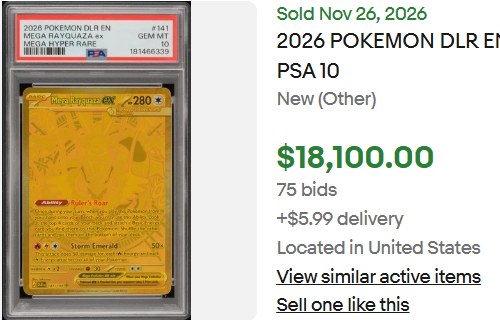
PSA has stopped grading English Mega Hyper Rares (MHRs), and that hit the gold Mega Rayquaza ex #141 from Delta Reign at a strange moment. The set came out only three weeks ago. That means the number of PSA 10s is now locked at whatever PSA graded before the cutoff, which I count at 102 copies. I think that is very likely every PSA 10 we will ever see.
If you got your MHR Rayquaza to PSA before the shutdown, congrats. You just hit the lottery. One PSA 10 sold on eBay on November 26 for $18,100 after 75 bids. I had been seeing sales around $16,000. That is insane money for an ultra modern card.
What PSA Announced
PSA posted the news on November 25, 2026. It stopped grading English-language Mega Hyper Rare cards effective immediately, citing a manufacturing issue. According to PSA, the gold foil on these cards can fade or develop visible patches of discoloration over time, even when the card is stored carefully. How bad it gets varies a lot. Some cards deteriorate badly and others show no change.
PSA’s reasoning is simple. There is no way to tell which cards will deteriorate, so it cannot give grades that will stay reliable. Here is what that means in practice, per PSA’s announcement:
- Grades already assigned stand. Slabbed MHRs keep their grades.
- Cards already submitted or in transit go back ungraded, and PSA waives the grading fee.
- Japanese Mega Ultra Rares are still eligible. PSA says they were made with a different process.
This covers every English gold Mega Hyper Rare in the Mega Evolution series, not only Rayquaza. But Rayquaza got hit hardest by the timing. Delta Reign, the sixth English Mega Evolution set, was released on November 6, 2026. It has 141 cards: 103 in the main set plus 38 secret rares, and the gold Mega Rayquaza ex at #141 is the last card in the set. Older MHRs had months of submissions behind them. This one had about two and a half weeks.
Where Prices Stand: Raw vs. Graded
Here are the latest sold prices for Mega Rayquaza ex #141 as of November 28, 2026:
A PSA 10 sells for about 56 times the raw price. Even that $13,201 figure is behind the market. The $18,100 eBay sale in the photo was about 37% higher, and the $16,000 sales I was seeing were about 21% higher.

The label matters a lot here. A PSA 10 sells for about 2.5 times a CGC 10 and more than 6 times a TAG 10. A PSA 9 at $2,000 sells for about one-seventh of a PSA 10. The PSA 10 label is now the scarce thing, not just the card.
Compare it with the other Rayquaza in the set. According to PokeInsider’s Card Data (as of November 27), the Special Illustration Rare Mega Rayquaza ex #138 sells for more raw ($292.82). But its PSA 10 sells for only $1,660.08. Raw, the SIR is the pricier card. In a PSA 10, the gold card is worth about 8 times more.
Why 102 Is Probably the Final Number
PSA is returning everything still in its system ungraded, so the PSA 10 count for #141 should be about final. A mid-November eBay listing showed a PSA 10 count of 91 out of 111 total graded. My 102 count is in line with a few more coming out of the queue before the cutoff.
I do not think PSA will reopen grading for MHRs. PSA’s whole case is that it can’t predict which cards will deteriorate. A future print run won’t fix that for cards already printed.
A supply of about 102 against a whole hobby of Rayquaza collectors is a very small number. When a pool that small meets that much demand, prices swing a lot. That explains how sales have run from about $13,000 to $18,100 within days.
Is PSA Creating Scarcity?
I have to ask the question: could PSA be limiting PSA 10s on purpose?
PSA’s stated reason is the gold foil defect, and the photos of faded Mega Charizard gold cards going around the hobby back that up. PSA also left Japanese Mega Ultra Rares eligible, which fits a production issue with the English cards rather than a blanket move.
Either way, the result for the market is the same. The PSA 10 count for #141 is fixed, and the new PSA 10s that normally show up for months after a release will never come.
What This Means for Raw Copies
The raw price used to include a lottery ticket: the chance to send it to PSA and get a $13,000+ slab. That ticket is gone. According to PokeInsider’s Card Data, the raw card is down 30.1% over the last 30 days and up 1.8% over the last 7. It has had 201 sales in the last 30 days, so raw copies are still trading.
If you own raw copies, you can still send them to other graders, if they keep accepting MHRs:
Be careful with the math. A CGC 10 at $5,280 and a TAG 10 at $2,107 are good outcomes compared with $234 raw. But the gold foil problem doesn’t go away because a different company grades the card.
The Delta Reign sealed market has already cooled. According to PokeInsider’s Card Data, the booster box sells for $198.10 ($5.50 per pack), down 26.3% over 90 days. The standard Elite Trainer Box sells for $80.59. Opening packs to chase a gold Rayquaza for a PSA 10 is no longer possible.
The Risks
- Deterioration inside the slab. PSA says the foil can fade over time and that grades already given will stand. A card in a PSA 10 slab today could show patches later, and PSA’s own announcement says it cannot tell which cards will be affected. If you are paying five figures, ask for current, high-resolution photos of the actual card and check the gold surface closely.
- A thin market. With about 102 copies, a handful of sales sets the price. The spread between $13,201 and $18,100 shows how quickly that can move in either direction.
- Ultra modern pricing. This is a three-week-old card selling for collector prices from day one. There is no long sales history to show where demand settles.
- Reputation. If more faded gold cards surface, all MHRs could get a reputation as risky cards, slabbed or not.
What I Am Doing
Here is where I stand. The PSA 10 count of about 102 is very likely final, I do not expect PSA to reopen MHR grading, and anyone who got a copy graded before the shutdown hit the lottery. $16,000, and now $18,100, is insane for an ultra modern card.
- Mega Rayquaza ex (Delta Reign): $213.88 raw, $13,201.21 in a PSA 10
What did you think?