

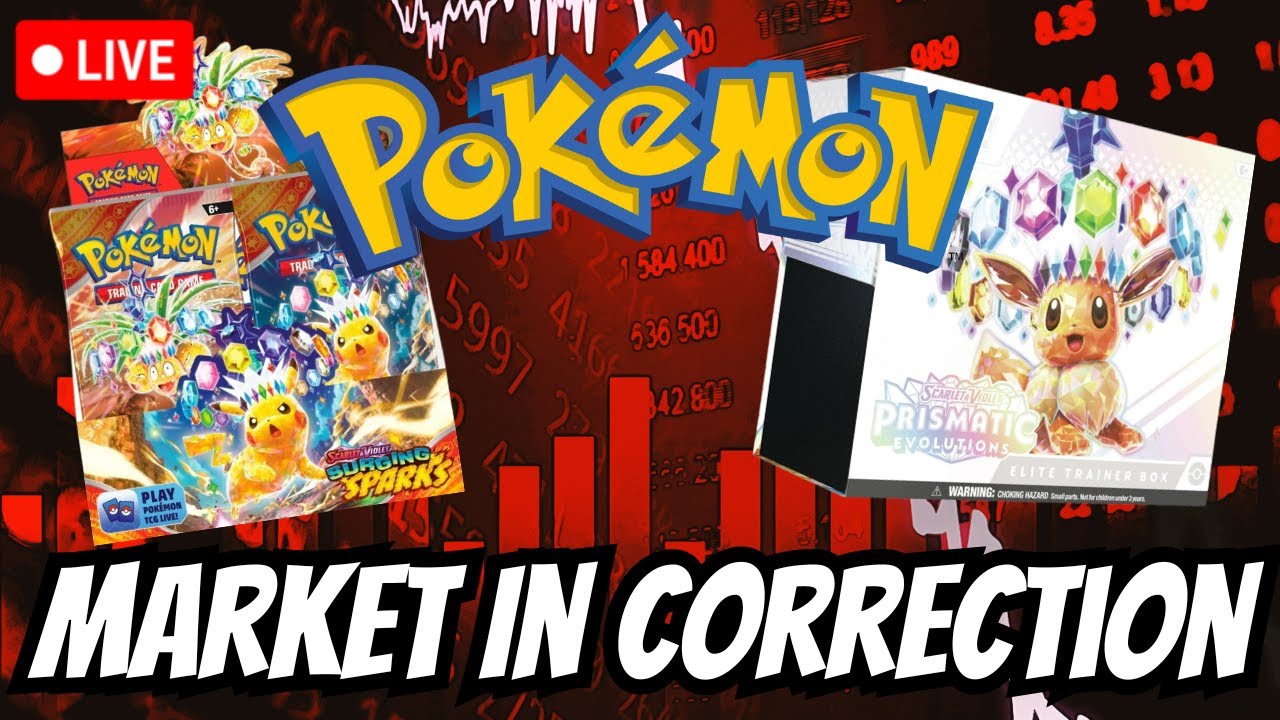
The Pokémon trading card market hasn’t turned a corner. Despite hopes for a holiday bounce, December 2025 data confirms what collectors have suspected: we’re in one of the sharpest cool-down phases in recent memory.
For buyers wondering when to jump in, understanding where prices stand—and where they’re heading—could mean the difference between a smart pickup and catching a falling knife.
The Numbers Tell the Story
The clearest signal comes from Umbreon VMAX Alt Art, affectionately known as “Moonbreon” among collectors. This card has long served as the bellwether for modern Pokémon prices. In raw condition, it fell from roughly $2,218 to $1,400 over the past few weeks—a 37% drop. Even graded PSA 10 copies retreated from $4,000 to around $3,250.
Part of the problem? The PSA 10 population now exceeds 23,000 copies. When that many top-grade examples exist, scarcity disappears and prices follow.
Here’s how other major cards have performed recently:
| Card | Price Movement | Current Price |
|---|---|---|
| Umbreon ex SIR (Prismatic Evolutions) | -15.5% | ~$1,050 |
| Charizard ex SIR (151) | -15% | $246.76 |
| Pikachu ex SIR (Surging Sparks) | -$40 | $339.75 |
| Mega Charizard X SIR (Phantasmal Flames) | -45% | ~$565 |
| Sylveon ex | -13% | $295 |
Nearly every top card from Surging Sparks dipped in December. The only exceptions were Durant ex and Archaludon ex, which posted minimal gains—hardly the stuff of a recovery.
Sealed Products Sitting on Shelves
Perhaps nothing illustrates this correction more clearly than walking into a retail store. For the first time in years, sealed Pokémon products aren’t flying off shelves.
Phantasmal Flames Elite Trainer Boxes, which scalpers pushed to $120+ at launch in mid-November, now sit around $90—approaching retail price. Prismatic Evolutions ETBs that commanded $400 on resale markets earlier in 2025 have crashed to roughly $110. Booster bundles dropped from $52 to $37.
This represents a fundamental shift. The demand-exceeds-supply dynamics that defined 2020 through 2023 have evaporated.
The culprit is straightforward: The Pokémon Company printed 10.2 billion cards in the fiscal year ending March 2025. Combine that flood of product with too many chase card variants splitting collector attention, and you’ve got textbook oversupply.
Where to Find Opportunity
Not everything is sliding. Two categories are actually showing strength, and they offer insight into where smart money is flowing.
Vintage cards—particularly 1st Edition Base Set and early Wizards of the Coast holos—remain resilient. A 1st Edition Base Set Charizard in PSA 10 still holds at roughly $263,000. Lower grades maintain value too, with PSA 7s at $11,069 and PSA 8s at $15,631.
More interesting for collectors with smaller budgets: Sun & Moon era alternate arts have climbed 30% or more during this same period. Team Up alt arts lead the gains. This suggests collectors are rotating capital out of oversupplied modern sets and into older products with genuine scarcity.
Even some vintage commons caught a bid. A viral “Kabuto King” story sparked buyouts of 1st Edition Gen I commons, pushing Kabuto from Fossil up $20 to $36.48. Jigglypuff from 1st Edition Jungle surged over 500%.
These are speculative buyouts rather than organic demand, but they show capital actively hunting for value in lower-supply vintage products.
What Buyers Should Consider
If you’re looking to buy, here’s the reality: analyst consensus points to continued correction through Q1 2026. Expectations hover around 20-30% total decline in modern sealed products and singles from their 2024 peaks.
Most experts characterize this as a healthy correction rather than a crash—prices adjusting toward sustainable collector demand instead of speculation-driven valuations. Some online discussions suggest certain modern cards could fall 80-90%, though most consider that extreme.
The primary bullish catalyst is Pokémon’s 30th anniversary in 2026, with the Pokemon Day Collection dropping January 30 and main celebrations on February 27. Shop owners expect this to reignite collector interest.
For now, patience likely pays. Competitive staples like Night Stretcher and Arven continue selling steadily at modest prices—reflecting gameplay demand rather than speculation. If you need cards to play with, buy them. If you’re investing, waiting for clearer signs of a bottom makes sense.
The Bottom Line
The Pokémon card market hasn’t transitioned from correction to growth. Virtually all key indicator cards show continued price declines ranging from 8% to 45%. Modern sealed products no longer sell out instantly.
Positive signs exist: vintage holds strong, Sun & Moon era products appreciate, and no panic selling has occurred. The market appears to be finding a fundamentals-based floor rather than collapsing.
But until modern card prices establish consistent upward trends and sealed products return to demand-exceeding-supply dynamics, this market remains firmly in correction territory. For buyers, that might actually be good news—just not yet.



