

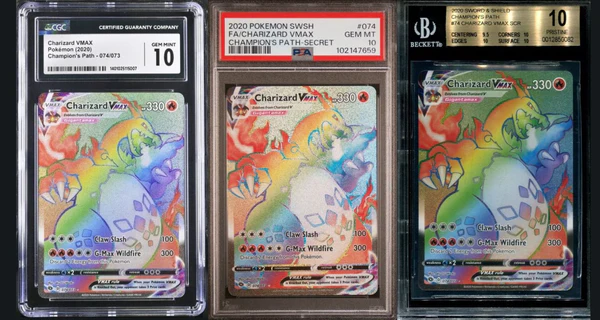
PSA still commands the highest resale prices in the Pokémon card market, but its grip on collectors is loosening. Between mounting controversies, rising fees, and growing competition, the grading landscape looks different than it did just two years ago.
Here’s what you need to know before submitting your next card.
PSA: Still King, But Facing Headwinds
For pure investment purposes, PSA remains the safest bet. PSA 10s consistently sell for 20-50% more than equivalent grades from competitors, with vintage WOTC-era cards showing the largest premiums.
But the company is dealing with serious problems. Parent company Collectors Holdings now controls roughly 83% of the grading market after acquiring SGC and Beckett, prompting congressional demands for an FTC antitrust investigation. Quality control complaints have intensified too—gem rates for modern cards dropped 10-12 percentage points after PSA quietly tightened centering standards without announcing the change.
Then there’s the pricing. PSA raised rates again in January 2025, with bulk submissions now costing $18.99 per card compared to $16.99 previously. Turnaround times stretch to 65 business days for economy tier.
CGC: The Clear Alternative
CGC has emerged as the definitive second option, grading 2.18 million cards in just the first half of 2025. Nearly all of those were Pokémon and trading card game submissions.
The value proposition is compelling. CGC charges $14 for bulk grading versus PSA’s $19+, includes subgrades on every card at no extra cost, and offers faster turnarounds. Their crystal-clear slabs have earned praise from collectors focused on display quality.
Most importantly for investors, CGC’s Pristine 10 grade has proven its market value. This ultra-premium designation requires all four subgrades at perfect 10 under magnification—and cards earning it regularly outsell PSA 10s. A 2024 Mew ex in CGC Pristine 10 fetched $2,085 compared to $1,600 for the PSA 10.
The price gap between standard CGC grades and PSA is also narrowing. Discounts have compressed from 40-50% in 2021 to roughly 20-30% today.
The Investment Math
| Card Value Range | Best Grading Option | Why |
|---|---|---|
| $500+ (Vintage) | PSA | Liquidity premium justifies cost |
| $100-500 (Modern Chase) | CGC | 40% lower fees offset 20-30% price gap |
| Under $100 (Bulk) | CGC or TAG | PSA premium rarely justified |
| Personal Collection | CGC, TAG, or ACE | Display quality over resale |
The calculation changes depending on what you’re grading. For a 1st Edition Base Set Charizard, PSA’s premium pricing pays for itself through higher auction results. But for a modern Scarlet & Violet card that might sell for $60 graded, the math flips.
Consider: PSA charges $75 for regular service versus CGC’s $45. If a CGC 10 sells for 25% less than PSA 10, you need the card to sell for at least $120 as a PSA 10 just to break even on that $30 difference.
Other Options Worth Knowing
TAG uses AI and computer vision to provide a 1000-point precision score alongside traditional grades. Their detailed reports show exact defect locations, eliminating the guesswork that frustrates collectors with other graders. Survey data shows 62% of respondents rate TAG’s accuracy as “very confident”—higher than PSA’s 23%. Market liquidity remains limited, but TAG works well for collectors prioritizing transparency.
ACE Grading dominates the UK and European market, processing 2,000 cards daily with 2-4 week turnarounds at competitive prices. Their custom labels extend card artwork for striking display pieces. The catch: ACE-graded cards command significantly lower prices internationally. This is a personal collection play, not an investment strategy for most markets.
Beckett still matters for one scenario—chasing the Black Label 10, which requires all four subgrades at perfect 10. These exceptionally rare grades can sell for multiples of PSA 10 prices on trophy cards. But Beckett’s market share has collapsed, with only 366,000 items graded in 2025 compared to CGC’s 2+ million.
What’s Next
The grading market is entering uncharted territory. Congressional antitrust scrutiny could reshape competitive dynamics. CGC’s submission volume jumped 70% year-over-year, demonstrating genuine market acceptance. AI-assisted grading from companies like TAG is attracting collectors frustrated by PSA’s perceived inconsistency.
PSA’s dominance isn’t disappearing—but dismissing alternatives as “not investment-worthy” is increasingly outdated advice. For modern Pokémon cards, strategic use of CGC or TAG can deliver equivalent or better net returns after grading costs.
The bottom line: Grade vintage with PSA, seriously consider CGC for modern cards, and keep an eye on TAG as a potential disruptor. The monopoly concerns surrounding Collectors Holdings may ultimately determine whether this competitive landscape persists—but for now, collectors have more viable options than ever before.



