

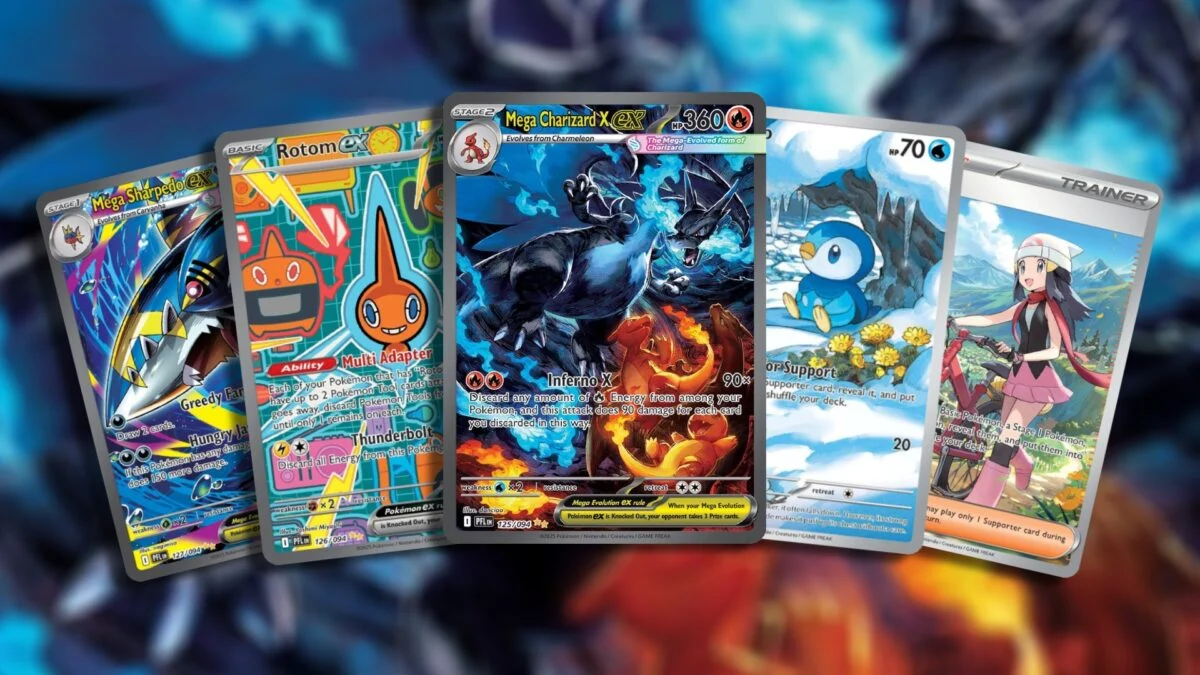
Three months after its November 14, 2025 release, Phantasmal Flames (ME02) has already become one of the most actively graded modern Pokémon sets in recent memory. Nearly 39,000 cards from the English set have passed through PSA’s hands, creating a surprisingly liquid graded market for a set that’s barely out of its infancy.
The headline numbers are staggering. PSA 10 graded copies of the set’s top cards command anywhere from 3× to 17× premiums over raw near-mint prices. But here’s the twist that most collectors aren’t talking about: it’s not the expensive chase cards delivering the fattest percentage returns. It’s the humble Illustration Rares sitting at the bottom of the price sheet.
If you’re trying to figure out where the smart money is heading in this set, here’s everything the data is telling us right now.
The Full PSA 10 Pricing Breakdown
Before diving into the analysis, let’s lay out the complete picture. The table below covers all ten major cards from Phantasmal Flames, ranked by PSA 10 estimated value, along with the raw near-mint price, the grading multiplier, and a confidence rating reflecting how much real sales data backs up each number.
| # | Card | Rarity | Raw NM | PSA 10 Est. | Multiplier | Data Confidence |
|---|---|---|---|---|---|---|
| 1 | Mega Charizard X ex 125/094 | SIR | $605.52 | ~$1,900 | 3.1× | ✅ High — verified sales |
| 2 | Mega Charizard X ex 130/094 | MHR | $388.34 | ~$3,250 | 8.4× | ⚠️ Low — very few sales |
| 3 | Dawn 129/094 | SIR | $36.47 | ~$235 | 6.4× | 🟡 Medium — estimates + retail |
| 4 | Mega Charizard X ex 109/094 | UR | $36.20 | ~$210 | 5.8× | ✅ High — active auctions |
| 5 | Mega Sharpedo ex 127/094 | SIR | $30.12 | ~$250 | 8.3× | ⚠️ Low — algorithmic est. |
| 6 | Mega Lopunny ex 128/094 | SIR | $21.63 | ~$140 | 6.5× | ✅ High — 7 tracked sales |
| 7 | Rotom ex 126/094 | SIR | $21.20 | ~$155 | 7.3× | 🟡 Medium — 1 auction + est. |
| 8 | Meowth 106/094 | IR | $13.69 | ~$234 | 17.1× | ✅ High — 30 tracked sales |
| 9 | Piplup 098/094 | IR | $10.76 | ~$165 | 15.3× | 🟡 Medium — algorithmic est. |
| 10 | Dawn 118/094 | UR | $8.18 | ~$93 | 11.4× | 🟡 Medium — estimates + retail |
A few things jump off the page immediately. The Mega Hyper Rare sits at the top in absolute dollars, but Meowth — a $13.69 raw card — punches absurdly above its weight with a 17.1× multiplier. That kind of spread between absolute value and percentage return is what makes this set so interesting for grading speculators.
The Charizard Trio Still Dominates in Raw Dollar Terms
No surprise here. Charizard cards continue to be the gravitational center of any modern Pokémon set, and Phantasmal Flames is no different.
Mega Charizard X ex 125/094 SIR is the flagship PSA 10 of the entire set. Verified sales paint a clear picture of where the market sits: $2,025 in late January 2026, with two earlier sales at $1,798 each in December 2025. Current Buy It Now listings on eBay hover between $1,850 and $2,000 with best offer options available. Earlier data from late 2025 showed prices as high as $2,750, which suggests the card peaked shortly after release and has since settled into a $1,800–$2,025 trading range.
With a PSA 10 population north of 233 and climbing, supply is gradually expanding. But demand hasn’t flinched. The 3.1× multiplier over raw is actually the lowest of any card on this list — a function of the already-steep $605 raw price rather than any weakness in demand.
Mega Charizard X ex 130/094 Mega Hyper Rare is the true unicorn. Only one confirmed PSA 10 sale exists on eBay from late December 2025, and the final price wasn’t publicly disclosed since it sold via best offer. Active Buy It Now listings range from $3,049 to $3,500, and algorithmic pricing tools peg it around $3,100–$3,250. PSA 9 copies have traded at $498–$550, which provides a useful anchor. But with such a razor-thin PSA 10 population, this card’s price could swing violently in either direction as more copies get graded. Proceed with caution.
Mega Charizard X ex 109/094 Ultra Rare is the everyman’s Charizard PSA 10. Live eBay auctions with 15–22 bids have been closing in the $170–$210 range, while Buy It Now listings stretch from $248 up to $420. The auction data — which tends to reflect actual market clearing prices better than optimistic listings — suggests the real value sits around $200–$250. At a 5.8× premium over the $36.20 raw price, it’s a solid entry point for collectors who want Charizard representation in a PSA 10 slab without dropping four figures.
The Real Story: Illustration Rares Are Delivering Monster Grading Premiums
This is where the data gets genuinely fascinating.
Meowth 106/094 is the standout card of the entire set when you look at it through a return-on-investment lens. At $234 in PSA 10 against a raw price of just $13.69, the 17.1× multiplier dwarfs everything else in the set. This isn’t some speculative estimate either — Meowth has 30 tracked PSA 10 transactions, roughly one sale per day, making it one of the most liquid graded cards in Phantasmal Flames outside of the Charizard SIR. Recent eBay sold prices cluster between $204 and $268, with a verified sale at $204 in mid-February 2026.
Piplup 098/094 follows right behind at an estimated $165 PSA 10 price, a 15.3× multiplier over its $10.76 raw cost. The data here is thinner — active auctions with multiple bids sit around $150, and Buy It Now prices range from $175 to $205 — but the pattern is unmistakable.
The takeaway is clear: grading cheap cards with beloved characters creates enormous percentage returns, even if the absolute dollar gains are smaller than what you’d see on a Charizard slab. A collector who buys Meowth raw at $14 and gets back a PSA 10 has turned a roughly $35–$65 total investment (card plus grading fees) into $234. That kind of math is hard to argue with.
Why This Inverse Relationship Exists
The economics behind this pattern are straightforward. PSA’s standard grading fees run $20–$50 per card depending on the service tier. For a $600 raw Charizard, that fee is negligible. But for a $10 Piplup, it represents a massive percentage of the card’s value. The result? Only collectors who are highly confident in their card’s condition bother submitting low-value cards for grading, which naturally constrains the PSA 10 supply. Meanwhile, demand for slabbed copies of fan-favorite characters like Meowth and Piplup stays strong regardless of the raw price point, because collectors want the security and display quality of a graded slab.
| Price Tier (Raw) | Typical PSA 10 Multiplier | Example Cards |
|---|---|---|
| Under $15 | 11×–17× | Meowth IR, Piplup IR, Dawn UR |
| $20–$40 | 5×–8× | Dawn SIR, Charizard UR, Lopunny SIR, Rotom SIR |
| $388–$606 | 3×–8× | Charizard SIR, Charizard MHR |
That gradient tells you everything you need to know about where the percentage play is.
The Mid-Tier: SIRs and URs Clustering Around $100–$250
Between the Charizard flagships and the Illustration Rare sleepers, there’s a middle tier of Special Illustration Rares and Ultra Rares that trade in a fairly tight band.
Dawn 129/094 SIR carries a PSA 10 estimate of $220–$255. With only 43 PSA 10 copies in the population out of 85 total graded, the gem rate hovers around 50%. PSA 9 copies trade around $49, creating a steep price cliff between grades. If you’re thinking about buying a PSA 9 to save money, the gap to PSA 10 pricing is wide enough that it may be worth holding out for the top grade.
Mega Sharpedo ex 127/094 SIR is the wild card. It has the least reliable pricing data of any card on this list. Algorithmic estimates as high as $364 likely overstate the market due to barely any actual sales data. Based on the multiplier patterns of comparable SIRs — Lopunny at 6.5×, Rotom at 7.3× — a more realistic PSA 10 estimate probably falls in the $200–$300 range. But there’s real uncertainty here, and anyone buying at current asking prices is taking on meaningful risk.
Mega Lopunny ex 128/094 SIR offers the best-documented pricing trajectory in this mid-tier, with seven tracked PSA 10 sales. The trend tells a familiar story for new sets: early premiums around $250 at Christmas gave way to more stable pricing around $127–$170 by January, with the current market price sitting around $140. That downward drift is worth watching, because it likely foreshadows what’s coming for other cards in the set as more copies get graded.
Rotom ex 126/094 SIR has one verified auction sale at $162 in early February, backed by 19 bids — solid evidence of genuine demand. Active listings sit at $175–$205, and algorithmic estimates of roughly $148 align reasonably well.
Dawn 118/094 UR rounds out the list as the most affordable PSA 10 at an estimated $83–$103. The PSA 10 population is extremely thin at just 11 copies. Its 11.4× multiplier over the $8.18 raw price makes it another candidate where grading economics strongly favor outsized returns — if you can land the 10.
What Smart Collectors Should Be Watching
Several forces are working on this market simultaneously, and understanding them matters if you’re thinking about buying or grading.
Supply is still building. This set is three months old. PSA 10 populations are growing steadily, and prices for most cards will likely moderate over the next six to twelve months as more slabs hit the market. The Mega Lopunny SIR already demonstrates this pattern clearly, with PSA 10 prices falling from $250 at Christmas to $130 by mid-January. Expect similar compression elsewhere.
Data quality varies wildly. The Meowth IR and Charizard SIR have dozens of tracked sales providing reliable, bankable market prices. The Mega Hyper Rare, Sharpedo SIR, and Piplup IR rely heavily on algorithmic estimates and tiny sample sizes. Cards flagged with lower confidence ratings in the table above should be treated as rough approximations, not hard targets.
The grading premium curve is your friend — if you’re submitting cards. The inverse relationship between raw price and PSA 10 multiplier is consistent and strong. For grading investors, the best percentage ROI comes from submitting popular character cards with low raw prices, assuming the card earns a 10. The math favors volume plays on $10–$15 raw cards over single high-dollar submissions, at least from a pure return perspective.
Character popularity is the X-factor. Meowth and Piplup don’t have the competitive playability or the rarity of Charizard, but they have something arguably more durable: universal fan appeal. Casual collectors — the people who buy one or two graded slabs for their shelf rather than building full master sets — gravitate toward characters they love. That demand floor isn’t going anywhere.
The Bottom Line
Phantasmal Flames has produced a graded market that rewards patience, selectivity, and a willingness to look beyond the obvious chase cards. Yes, the Charizard SIR and Mega Hyper Rare are the headliners, and they’ll hold that status for the life of the set. But the data is telling a more nuanced story.
If you’re buying PSA 10 slabs to hold, the Illustration Rares — particularly Meowth at $234 with robust liquidity — offer arguably the most compelling risk-reward profile in the set. If you’re grading raw cards, the multiplier data strongly favors submitting lower-value cards with character appeal over expensive pulls where the percentage upside is capped.
And if you’re sitting on the sidelines waiting? That might be the smartest play of all. With populations still climbing and early-release premiums fading, the next three to six months should bring better entry points across the board.



