

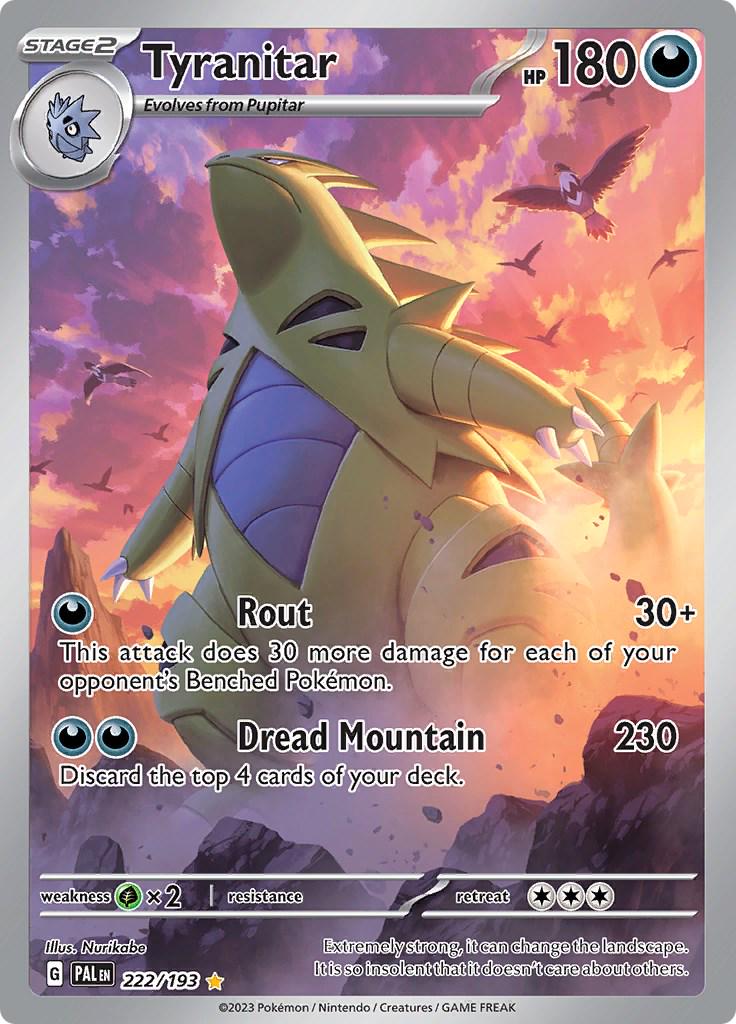
Tyranitar has always held a special place in the hearts of Pokémon collectors. The pseudo-legendary’s intimidating design and competitive viability have made it a fan favorite since Generation II, and that popularity translates directly into the card market. But not all Tyranitar cards are created equal—and in 2025, some are proving to be far better investments than others.
The Raw Market Leaders
At the top of the food chain sits Shining Tyranitar from Neo Destiny, commanding roughly $1,700 in raw condition. This iconic card from the early 2000s remains the crown jewel of Tyranitar collecting, featuring the distinctive “shining” foil pattern that defined an era.
The Tyranitar Staff Prerelease XY130 follows at around $800, a reminder that promotional cards with limited distribution can hold serious value. The Aquapolis H28 Holo rounds out the top three at $616, representing the beloved e-reader era that many collectors consider the peak of Pokémon card artistry.

| Card | Set | Raw Price |
|---|---|---|
| Shining Tyranitar | Neo Destiny | $1,700 |
| Tyranitar Staff Prerelease XY130 | XY Promos | $800 |
| Tyranitar H28 Holo | Aquapolis | $616 |
| Tyranitar (12) | Neo Discovery | $401 |
| Mega Sableye & Tyranitar GX Alt Art | Unified Minds | $327 |
| Tyranitar Delta Species | Delta Species | $256 |
| Dark Tyranitar (19) | Team Rocket Returns | $250 |
| Tyranitar ex | Unseen Forces | $239 |
| Tyranitar V Alt Art | Battle Styles | $207 |

Where Grading Changes Everything
Raw prices only tell part of the story. The real action happens when you look at PSA 10 multipliers—the difference between what a raw card sells for versus what it fetches in gem mint, professionally graded condition.
The 1st Edition Neo Discovery Tyranitar is the standout performer here. Raw copies sell for roughly $230, but achieve a PSA 10 grade and you’re looking at $4,100 to $4,400. That’s a staggering 19x multiplier, making it the most lucrative grading opportunity in the entire Tyranitar lineup.
Why such a dramatic premium? Print quality. Cards from this era were notoriously inconsistent, with centering issues, print lines, and surface imperfections plaguing even pack-fresh copies. Finding one that grades a perfect 10 is genuinely difficult, and the market rewards that scarcity.
The Aquapolis H28 tells a similar story. At roughly $616 raw, a PSA 10 copy sold for $5,750 in November 2025, with previous sales ranging from $3,850 to $4,550. That 9x multiplier reflects the same vintage print quality challenges.
Even the mighty Shining Tyranitar, despite its already-high raw price of $1,700, jumps to $8,100-$11,190 in PSA 10 condition—a 5-6x premium that demonstrates how condition sensitivity increases with card prestige.
Modern Cards Hold Their Own
Don’t sleep on the newer releases. The Tyranitar V Alternate Art from Battle Styles has become a modern classic, featuring gorgeous full artwork that showcases the Pokemon rampaging through a city. Raw copies run about $207, while PSA 10s fetch $670-$820—a 3.5x multiplier that’s respectable for a card only a few years old.
The Mega Sableye & Tyranitar GX Alternate Art from Unified Minds offers similar appeal at roughly $327 raw, climbing to $1,100-$1,350 in PSA 10. Modern alternate arts benefit from better quality control than vintage cards, but the competition for gem mint grades remains fierce among a larger collector base.
What Smart Buyers Should Consider
The data points toward a clear strategy for different collector types.
For serious investors willing to take calculated risks, hunting for raw 1st Edition Neo Discovery Tyranitars in near-mint condition offers the best potential return. That 19x multiplier is exceptional, though you’ll need a keen eye for condition and some luck at the grading company.
Collectors seeking safer vintage exposure might prefer the Shining Tyranitar or Aquapolis H28. Both carry lower multipliers but represent established, highly liquid cards with proven demand.
Those building a modern Tyranitar collection should prioritize the Battle Styles alternate art. It’s accessible, visually stunning, and has demonstrated consistent market interest. The grading premium is modest but reliable.
The Bottom Line
Tyranitar cards benefit from something many Pokemon lack: cross-generational appeal. The character resonates with collectors who grew up in the late 90s and early 2000s, while alternate art variants have introduced it to newer audiences.
Vintage remains king for pure investment potential, with the e-reader and Neo eras commanding the most dramatic grading premiums. But modern alternate arts offer a compelling entry point for collectors who want quality without five-figure commitments.
Whatever your budget, Tyranitar belongs on your radar. The dark-type titan has proven it can dominate more than just the battlefield.



