

The Pokémon TCG market moves fast, and nowhere is that more evident than in the early days of a major set release. While collectors scramble for the flashiest chase cards, smart investors know the real opportunity often lies in finding the undervalued gems—cards with identical scarcity to the market leaders but trading at a fraction of the price.
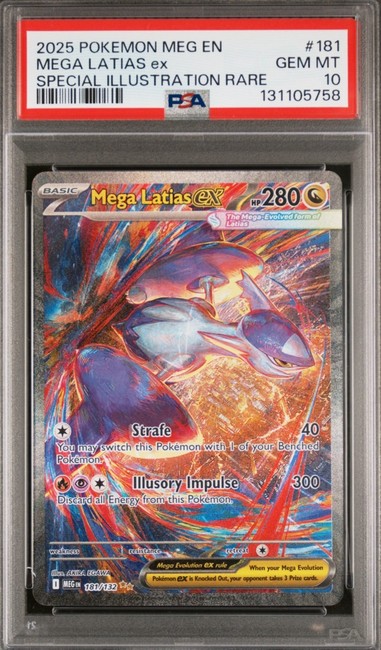
Enter the Mega Latias EX Special Illustration Rare from the 2025 Mega Evolution set. This card might just be the most compelling investment opportunity in modern Pokémon right now.
The Numbers Don’t Lie
Let’s start with the hard facts. The Mega Latias EX SIR (#181/132) has a pull rate of approximately 1 in 267 booster packs. That’s exceptionally rare by any measure, placing it firmly in the upper echelon of modern chase cards. Raw copies are currently valued around $120, while PSA 10 graded examples are averaging $700—though recent sales have ranged from $492 to $565 as the market finds its footing.
Here’s where it gets interesting: the Mega Lucario EX SIR (#188/132), widely considered the set’s flagship card, shares the exact same 1 in 267 pull rate. Yet Lucario’s PSA 10 copies are selling for $1,034 to $1,612—more than double what Latias commands.
Same rarity. Dramatically different prices. That gap represents opportunity.
Why the Disconnect?
The market’s current pricing reflects what’s hot right now rather than fundamental value. Lucario benefits from immediate competitive relevance in gameplay and broader mainstream recognition. But here’s the thing about collectibles: competitive utility is temporary. Scarcity and artistic merit? Those are forever.
Latias brings serious credentials to the table. As a Legendary Pokémon and half of the beloved Eon Duo, it carries substantial nostalgic weight with long-time fans. The card showcases the Pokémon’s Mega Evolution form—a mechanic that resonates deeply with players who grew up during the Generation VI era.
The Akira Egawa Factor
If scarcity alone isn’t enough to convince you, consider the artwork. The Mega Latias SIR is illustrated by Akira Egawa, an artist who’s built a serious following in the TCG community for their kinetic, dynamic style. This particular piece depicts Mega Latias soaring over a nighttime cityscape, with colorful motion lines that practically vibrate with energy.
The composition works brilliantly in a PSA slab. The contrast between the brilliantly lit figure and dark background creates maximum visual impact, making it a showcase piece that collectors will want to display. Cards with this kind of aesthetic appeal tend to hold value independently of gameplay considerations—and they often develop an “artist premium” that compounds over time.
Timing Is Everything
Now for the reality check: this isn’t a “buy immediately” situation. Early data suggests PSA 10 return rates for new cards can be surprisingly high—sometimes north of 80%. That means we’re likely in a period of temporary oversupply as graders flood the market with fresh slabs.
This is actually good news for patient investors. The near-term price depression creates a strategic entry point. Most analysts suggest waiting until Q2 or Q3 of 2026, after the initial grading rush subsides but before the set goes out of print and sealed product prices really start climbing.
The Mega Evolution set is already showing strength in the sealed market, with booster boxes consistently selling above $220—more than 150% of MSRP. That premium on sealed product means fewer boxes get opened over time, which directly supports the long-term value of graded singles.
The Competitive Landscape
Let’s put Latias in context with its set rivals:
- Mega Lucario EX SIR: $1,034-$1,612 (PSA 10), 1 in 267 pull rate
- Mega Latias EX SIR: $500-$700 (PSA 10), 1 in 267 pull rate
- Mega Gardevoir EX SIR: Estimated $800+ (PSA 10), 1 in 267 pull rate
All three cards share identical rarity, yet Latias trades at the bottom of this tier. As the set matures and collectors shift focus toward completion rather than gameplay utility, that valuation should normalize. The percentage upside on Latias far exceeds what you’d get from buying Lucario at its already-elevated price.
The Long Game
This investment thesis rests on a simple premise: fixed scarcity plus growing demand equals appreciation. The 1 in 267 pull rate isn’t changing. Once the set goes out of print, no new supply enters the market. Meanwhile, the modern graded card market has shown explosive growth—some segments posted 105% gains between 2024 and 2025 alone.
Special Illustration Rares represent the aesthetic peak of their era, much like the celebrated Alternate Arts from Sword & Shield. These cards are positioning themselves as the next generation of vintage blue-chip assets. Twenty years from now, collectors will look back at cards like this Mega Latias as defining pieces from the modern TCG renaissance.
Real Talk: The Risks
No investment is without risk. The near-term price could drift lower if grading submissions remain heavy. There’s also the possibility that The Pokémon Company extends the print run, though current sealed market strength suggests that’s unlikely.
The key mitigation strategy is patience. Don’t chase the card at $700 if you’re seeing regular sales in the $500 range. Wait for stability. Monitor sealed product prices—if booster boxes start falling back toward MSRP, that’s a red flag for oversupply.
The Bottom Line
The Mega Latias EX SIR in PSA 10 grade represents a rare alignment of scarcity, artistic merit, and relative undervaluation. It’s trading at a significant discount to cards with identical pull rates, creating a strategic opportunity for investors willing to play the long game.
This isn’t a flip play. It’s a five-year hold with the potential for substantial appreciation as the market corrects its pricing inefficiencies. For investors building a modern TCG portfolio, this card deserves serious consideration—just make sure you time your entry right.
Sometimes the best investments are the ones the market hasn’t fully figured out yet.



