

The card grading industry is experiencing a seismic shift. What was once PSA’s uncontested domain now faces serious competition from CGC Cards, and collectors are caught in the middle wondering where to send their prized possessions. Let’s cut through the marketing noise and examine what’s actually happening in the grading market right now.
The Tale of the Tape
PSA remains the 800-pound gorilla. In 2024, they graded 15.33 million cards—9.1 million sports cards and 6.23 million trading card game and non-sports cards. That’s roughly 60% of the entire grading market, and their slabs still command the highest resale premiums. When you’re trying to flip a card quickly, a PSA 10 typically sells faster and for more money than the same card in a CGC holder.
But here’s where it gets interesting. CGC is growing at a blistering pace that should make PSA executives nervous. In the first half of 2025, CGC’s sports card submissions exploded by 189% year-over-year. Their total volume jumped 140% compared to the previous year. They’re not just participating in the market—they’re actively stealing share from the established players.
Where Your Money Actually Goes
The pricing difference between these companies isn’t subtle, and it matters for anyone submitting cards in bulk. CGC’s economy service runs $17 per card with a maximum declared value of $1,000. PSA’s comparable “Value” tier costs $27.99 per card, but here’s the kicker—it caps out at just $500 in declared value.
Think about what this means for modern cards. You pulled a hot rookie card worth $750. With CGC, you’re paying $17. With PSA, that card gets bumped into a more expensive tier because it exceeds the $500 limit. This pricing structure isn’t an accident—it’s strategic warfare, and CGC is winning the battle for mid-tier modern submissions.
Turnaround times are comparable on paper. CGC promises 40 business days for economy service versus PSA’s 45 business days, though both exclude shipping time. In practice, actual wait times can vary significantly based on submission volume and time of year.
The Grading Standards Debate
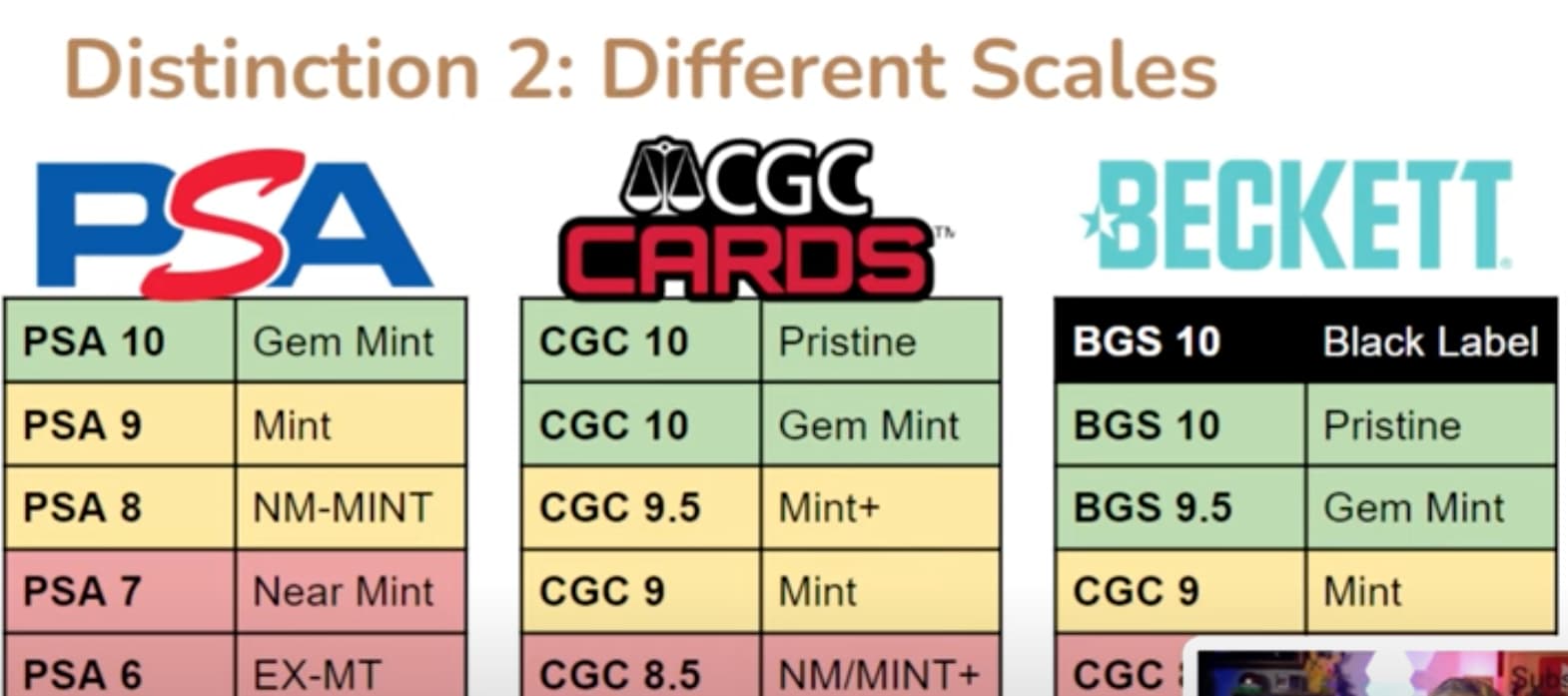
PSA uses a straightforward 10-point scale where PSA 10 represents Gem Mint condition. It’s simple, it’s established, and the market understands it. CGC takes a different approach with half-point grades (8.5, 9.5) and optional sub-grades that break down centering, corners, edges, and surface. They’ve also introduced the Pristine 10 grade for truly flawless cards.
Here’s the uncomfortable truth that collectors whisper about: CGC is often perceived as the stricter, more consistent grader. The company cut its teeth grading comic books, where precision matters enormously, and that meticulous approach carried over to cards. PSA, despite its market dominance, occasionally faces criticism about grading inconsistency—particularly frustrating when you’re spending serious money on submissions.
The Liquidity Premium Problem
None of this changes one fundamental reality: PSA slabs sell for more money. It’s not about which company grades more accurately. It’s about what buyers are willing to pay, and right now, they pay premiums for PSA. This liquidity advantage stems from decades of market trust, not necessarily superior grading.
If you’re buying cards as investments meant to flip quickly, PSA still makes the most sense despite the higher costs. The resale premium often covers the price difference. But if you’re a long-term collector who values accurate grading and detailed condition reporting, CGC’s approach might align better with your priorities.
Looking Under the Hood
Both companies are investing heavily in technology, particularly artificial intelligence for grading consistency and counterfeit detection. PSA launched an AI-powered scanner in their mobile app that can detect fakes and estimate prices in under three seconds. It’s impressive tech, but here’s the catch—PSA can’t fully automate grading with AI without creating a massive problem.
PSA guarantees compensation for erroneously graded cards. If they implement an AI system that’s significantly more accurate than their human graders, millions of legacy cards might suddenly be considered “over-graded” by the new standard. The financial liability could be catastrophic. This explains why PSA is taking a measured, human-verified approach to AI integration rather than rushing headlong into full automation.
CGC faces fewer constraints here as a newer company with less legacy liability hanging over their head.
The Strategic Divide
PSA’s parent company, Collectors Holdings, is consolidating the domestic market through acquisitions, most notably the planned purchase of SGC. This gives them control over multiple grading brands and allows them to segment the market strategically—PSA for modern, high-volume cards, and potentially SGC for vintage material where it has historical strength.
Meanwhile, CGC is going global. They’re opening international facilities like their Munich location to reduce shipping friction for overseas collectors. It’s a smart play—eliminate the hassle of international shipping, and submissions will follow.
The Bottom Line
Your choice between PSA and CGC depends entirely on your objectives. Chasing maximum resale value on investment cards? PSA remains the safer bet. Submitting modern cards worth $500-$1,000 in bulk? CGC’s pricing structure saves you significant money. Want detailed sub-grades and arguably more consistent grading? CGC delivers that better than anyone.
The market is clearly trending toward a two-company race between these titans. SGC and other smaller graders will continue serving niche segments, but the volume and capital are concentrating at the top. That’s good news for competition and pricing right now, though it raises questions about what happens when the dust settles and two companies control the vast majority of the market.
For collectors submitting cards in 2025, the smartest move might be diversifying between both companies based on the specific cards you’re sending. High-value vintage for PSA’s liquidity premium. Modern bulk submissions for CGC’s cost efficiency. The grading wars are far from over, and right now, collectors are the ones benefiting from the competition.



