

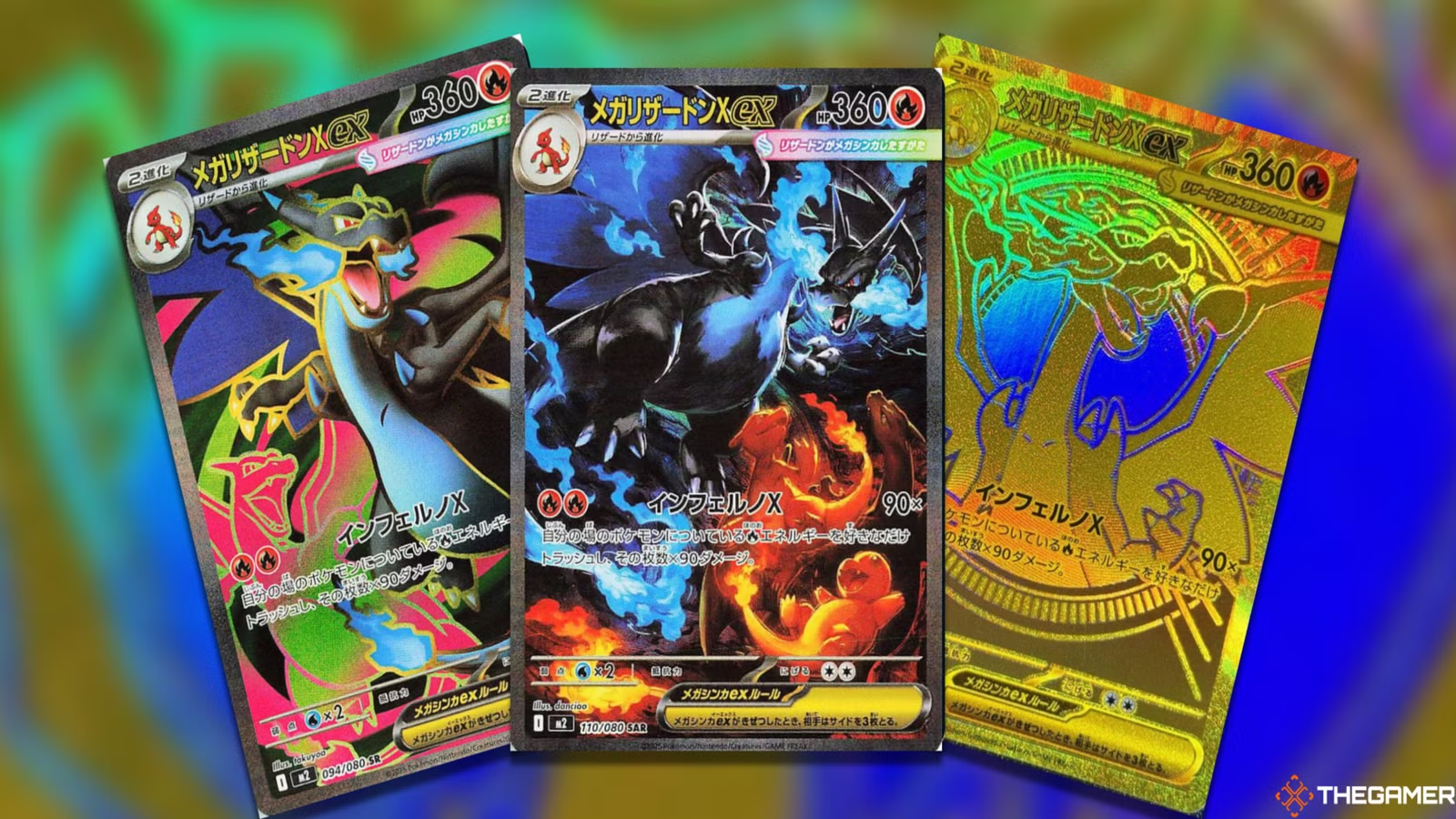
A new ultra-rare card is set to shake up the Pokémon collecting world—but not all versions are created equal.

When The Pokémon Company International unveiled Mega Charizard X ex at the 2025 World Championships, collectors didn’t just lose their minds—they opened their wallets. One fan’s reaction summed up the frenzy: “SOOOOOO SICK.” But beneath the hype lies a calculated investment opportunity that could see this card fetch between $1,220 and $1,550 within a year of its English release.
The catch? You need to know which version to buy.
Two Cards, Two Destinies
Mega Charizard X ex is launching with a split personality. The set-pull variant—rumored to carry a new “Mega Attack Rare” designation—will be the crown jewel, extracted from booster packs of the Mega Evolution—Phantasmal Flames expansion dropping November 14, 2025. Meanwhile, a guaranteed promotional version ships inside the Mega Charizard X ex Ultra Premium Collection, retailing around $264.
The difference in projected value? Staggering. While the set-pull card is forecast to climb toward $1,500, the promo version will languish between $80 and $130—essentially acting as packing material for the booster boxes it accompanies.
This isn’t speculation pulled from thin air. It’s rooted in what analysts are calling the “Charizard Value Index”—a custom metric tracking how the franchise’s most iconic Pokémon consistently outperforms the broader trading card market.
The Japanese Crystal Ball
To understand where this card is heading, collectors are watching Japan obsessively. The Japanese version (M2 110/080) hit the market in September 2025 and immediately defied expectations. Within one month, raw copies were selling for $531 to $667—a floor typically reserved for cards at their peak value, not their launch.
PSA 10 graded versions? They exploded to between $1,534 and $2,370. By November, projections had raw cards climbing past $1,000, with graded copies pushing $3,500.
This wasn’t normal market behavior. The elevated starting price suggests something unprecedented: engineered scarcity from day one. When you factor in foreign buyers capitalizing on a weak yen and limited domestic supply, you get a perfect storm that’s already locked in a high baseline before the English release even happens.
The Charizard Tax
Historical data reveals what collectors have long suspected: Charizard cards don’t play by normal rules. Analysis of the five most recent high-rarity Charizard releases—from Champion’s Path to Obsidian Flames—shows an average growth multiplier of 1.52x over twelve months. That means a card starting at $100 reliably hits $150 within a year, even after the initial release hype dies down.
But Mega Charizard X ex isn’t starting at $100. It’s starting at $667, based on Japanese market performance. Apply that 1.52x multiplier to an already-inflated base, add scarcity premiums, and you land squarely in four-figure territory.
The artwork itself—illustrated by danciao—depicts the entire Charmander evolutionary line bathed in the blue flames of Mega Charizard X’s transformation. It’s nostalgia weaponized, targeting collectors who grew up with Generation 6 games and remember when Mega Evolution felt revolutionary.
The Competitive Wildcard
The card isn’t just pretty—it’s potentially devastating in competitive play. Its “Inferno X” attack scales with discarded Fire Energy, offering theoretically unlimited damage. As a three-prize card, it carries inherent risk, but early competitive analysis suggests it could define the meta. That playability creates a functional price floor; even if collecting interest wanes, players will keep demand steady.
The Forecast
Conservative models—assuming higher print runs and declining competitive relevance—still place the set-pull variant between $880 and $1,100 by late 2026. The neutral scenario, accounting for standard Special Illustration Rare scarcity and sustained nostalgia demand, projects $1,220 to $1,550. Aggressive forecasts, should the Mega Attack Rare classification prove exceptionally scarce, push toward $2,500.
Meanwhile, the UPC promo remains essentially worthless as an investment vehicle, its value capped by guaranteed availability and mass production.
For collectors wondering whether to chase the set-pull or settle for the promo, the math is brutal: one version is a potential nest egg, the other is just another card. The only question is whether you’re willing to gamble on finding it in packs—or pay the premium to secure it now.



